0800 464 7025


Choosing the correct temporary chiller starts with one essential question: how much cooling capacity does your site actually need?
Chiller capacity is typically expressed in kilowatts (kW), but calculating the right capacity involves more than simply matching the rating of an existing unit.
The amount of heat that needs to be removed, required water temperatures, flow rate, operating conditions and changes in demand can all affect the temporary chiller capacity required. Getting this calculation right is important. An undersized chiller may struggle to maintain the required temperature, while significantly oversizing equipment can lead to inefficient operation and unnecessary compressor cycling.
So, how do you calculate the capacity you need?
What Is Chiller Capacity?

Chiller capacity is the rate at which a chiller can remove heat from a system.
For temporary chiller hire, this needs to be sufficient to remove the heat being generated by the building, equipment or industrial process while maintaining the required operating temperatures.
A higher heat load requires greater cooling capacity.
However, the required capacity can change significantly between applications. Cooling an office building, for example, presents a very different load profile from cooling industrial machinery or supporting a manufacturing process.
That is why determining the actual cooling load is the starting point for temporary chiller sizing.
The Basic Chiller Capacity Calculation
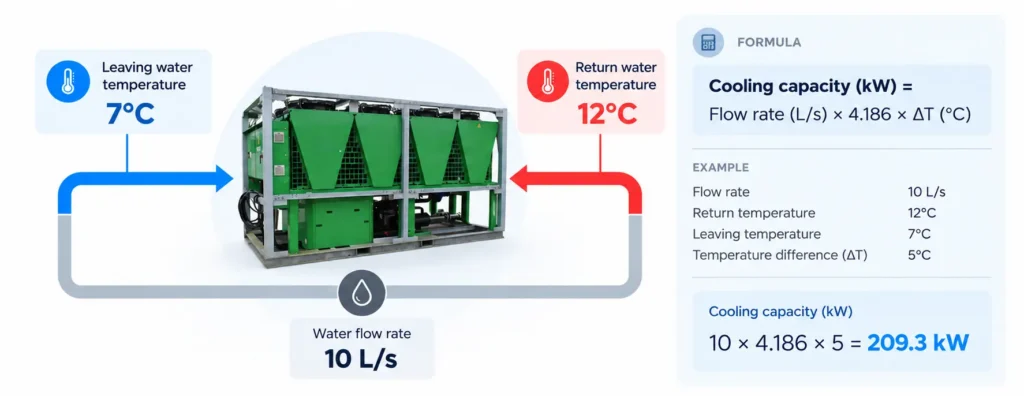
For an existing chilled-water system, cooling capacity can be calculated when you know the water flow rate and the temperature difference between the flow and return.
A commonly used calculation for water is:
Cooling capacity (kW) = Flow rate (L/s) × 4.186 × Temperature difference (°C)
The temperature difference, often referred to as ΔT (delta T), is the difference between the water entering and leaving the chiller.
Example Chiller Capacity Calculation:
Imagine a system has:
- A water flow rate of 10 L/s
- Return water temperature of 12°C
- Required leaving water temperature of 7°C
The ΔT is therefore:
12°C – 7°C = 5°C
The calculation becomes:
10 × 4.186 × 5 = 209.3kW
The cooling requirement at those conditions is approximately 209kW.
This provides a useful starting point, but it doesn’t automatically mean that selecting the nearest 209kW chiller is the correct solution. The actual temporary installation and operating conditions still need to be considered.
What If You Don’t Know Your Cooling Load?
Not knowing your exact cooling load is common, especially during an unexpected chiller failure or emergency when you need a temporary solution quickly.
Rapid Energy’s team can assess your existing system, application, and operating requirements to determine the cooling load and the appropriate temporary chiller capacity.
This means you don’t need to have all the technical information available before getting in touch.
Speak to our team and we can help identify the right temporary cooling solution for your site.
Key Factors That Affect Temporary Chiller Capacity
The calculated kW requirement is an important starting point, but temporary chiller sizing shouldn’t be based on that figure alone.
Several site-specific factors can affect the capacity and configuration required.

1. Flow and Return Temperatures
The temperatures required by the process or HVAC system have a direct relationship with cooling duty.
It is therefore important to establish both the required leaving water temperature and the expected return temperature. The difference between these temperatures forms the ΔT used within the cooling capacity calculation.
2. Water Flow Rate
The temporary chiller must work with the required system flow rate.
Two systems requiring similar cooling capacities can have very different flow requirements depending on their operating temperatures and ΔT. Flow rate therefore needs to be considered alongside capacity when specifying the chiller, pumps and associated temporary equipment.
3. Peak and Minimum Cooling Demand
Cooling loads rarely remain constant. Production can increase or decrease, equipment can start and stop, occupancy can change and outdoor temperatures can fluctuate.
The temporary system needs sufficient capacity for periods of peak demand while also being able to operate effectively when the cooling load falls.
4. Ambient and Site Conditions
The conditions surrounding the temporary installation can also influence chiller selection. Air-cooled chillers reject heat into the surrounding air, so ambient temperature and sufficient airflow need to be considered, particularly during warmer conditions.
Available electrical supply, installation space, access and the distance between the temporary chiller and connection point can also influence how the overall system is configured.
Should You Add Extra Capacity to a Chiller Calculation?
Some contingency may be appropriate, particularly where loss of cooling could affect production or building operation.
However, there is no single percentage that should automatically be added to every chiller calculation.
The appropriate allowance depends on factors such as:
- How accurately the cooling load is known
- Expected fluctuations in demand
- Ambient conditions
- The criticality of the application
- Required redundancy
For a critical application, the solution may involve additional standby capacity rather than simply installing one significantly oversized chiller.
The objective is to provide sufficient cooling capacity and resilience without creating a system that spends most of its time substantially oversized for the actual demand.
Calculating Capacity for Variable Cooling Loads
Cooling demand can change considerably throughout the day, particularly in commercial and industrial environments. Looking at both the peak load and minimum expected load can help determine the most appropriate temporary chiller capacity.

For example, a manufacturing site might reach a peak requirement of 600kW, but operate at around 250-300kW for significant periods.
When assessing a variable cooling load, consider:
- Peak cooling demand – the maximum capacity the system needs to provide.
- Typical operating load – the level of cooling required for most of the day.
- Minimum cooling demand – how far the load may fall during quieter periods.
- Changes in demand – such as different production shifts or equipment starting and stopping.
Where the difference between peak and typical demand is significant, multiple temporary chillers can sometimes be used to stage capacity as requirements change. The system should be designed around the overall load profile rather than simply the highest kW figure. This is also why part-load performance is important when selecting and sizing a temporary chiller.
Information We Need to Size Your Temporary Chiller
If you contact Rapid Energy about temporary chiller hire, having some basic information available can help establish the requirement more quickly.

Where possible, useful information includes:
- Existing chiller capacity
- Required flow and return temperatures
- Water flow rate
- Application or process being cooled
- Normal and peak cooling demand
- Available electrical supply
- Connection sizes
- Site access and installation space
- Required hire duration
- Contingency or standby requirements
Don’t worry if all of this information isn’t available, particularly during an emergency. Rapid Energy’s engineers can work with your site team to establish the cooling requirement and determine an appropriate temporary solution.
Rapid Energy’s Temporary Chiller Fleet
Once the cooling requirement has been calculated, the next step is matching it to suitable temporary equipment.
Rapid Energy’s chiller hire fleet ranges from 4kW to 760kW, giving us flexibility across different commercial and industrial applications.
Depending on the requirement, a temporary solution could involve:
- A single appropriately sized chiller for a relatively consistent cooling load
- Multiple chillers working together for higher-capacity requirements
- Staged capacity where cooling demand varies significantly
- Duty and standby arrangements where additional resilience is required
The chiller itself is only part of the system. Where required, Rapid Energy can also provide supporting equipment such as pumps, temporary hoses, connections and heat exchangers.
The aim is to provide the right capacity and configuration for the application, rather than simply selecting equipment based on its maximum kW rating.
Frequently Asked Questions
How Do I Calculate What Size Chiller I Need?
For a chilled-water system using water, cooling capacity can be estimated using the flow rate and temperature difference:
Cooling capacity (kW) = Flow rate (L/s) × 4.186 × ΔT (°C)
The result should then be considered alongside peak demand, ambient conditions, system requirements and any necessary contingency.
What Happens If a Temporary Chiller Is Too Small?
An undersized chiller may be unable to remove heat at the rate required by the application. This can prevent the system from reaching or maintaining the required temperature, particularly during periods of peak demand.
Is It Better to Oversize a Temporary Chiller?
Not necessarily. Some additional capacity may be appropriate, but significant oversizing can result in inefficient operation and increased compressor cycling. The system should be sized around both peak demand and expected operating conditions.
Can Rapid Energy Calculate My Cooling Requirement?
Yes. Rapid Energy’s engineers can assess your application, existing system and operating conditions to help establish the cooling requirement and specify an appropriate temporary chiller solution.
What Temporary Chiller Capacities Does Rapid Energy Offer?
Rapid Energy’s packaged chiller fleet ranges from 4kW to 760kW, with different capacities available to suit commercial and industrial applications. Multiple chillers can also be configured where greater capacity, staged cooling or additional resilience is required.