0800 464 7025

Indirect diesel fired heaters provide high-capacity temporary heating for commercial and industrial environments. They use diesel fuel to generate heat, with a heat exchanger keeping the combustion process separate from the warm air supplied to the building.
The process relies on several components working together, including a burner, combustion chamber, heat exchanger, fan, flue and warm-air ducting.
Understanding how these components work together helps explain why IDF heaters are well suited to warehouses, factories, construction projects and other commercial and industrial applications.
How Does an Indirect Diesel Fired Heater Work?
An IDF heater burns diesel within an enclosed combustion chamber. The heat generated is transferred through a heat exchanger, while a fan moves a separate stream of air across the heated surfaces.
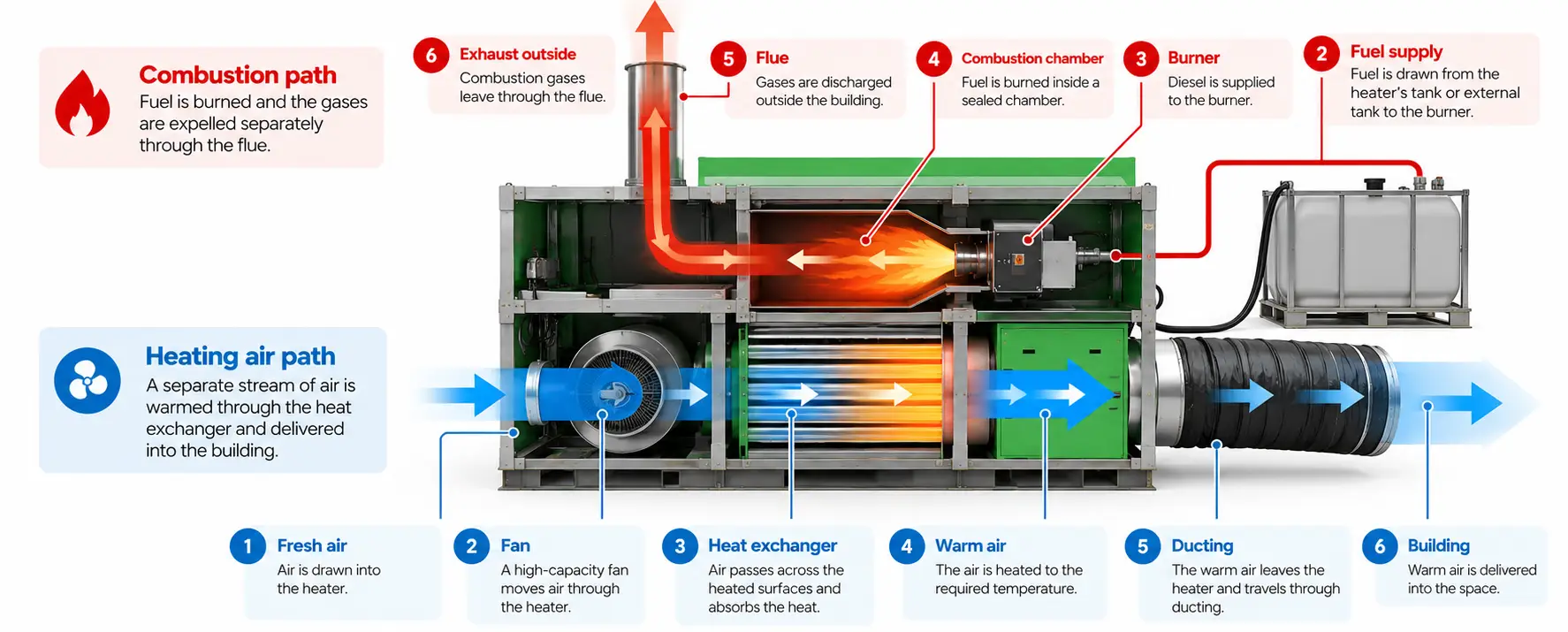
The air absorbs this heat before being pushed through the heater outlet and into temporary ducting, which carries the warm air to the required area.
At the same time, the gases created during combustion follow a separate route and are discharged through the flue.
In simple terms, the heater creates two separate paths:
Heating air:
Fresh air → Fan → Heat exchanger → Warm air → Ducting → Building
Combustion:
Fuel → Burner → Combustion chamber → Flue → Exhaust outside
This separation is at the centre of how an indirect diesel fired heater works.
The Heating Process Step by Step
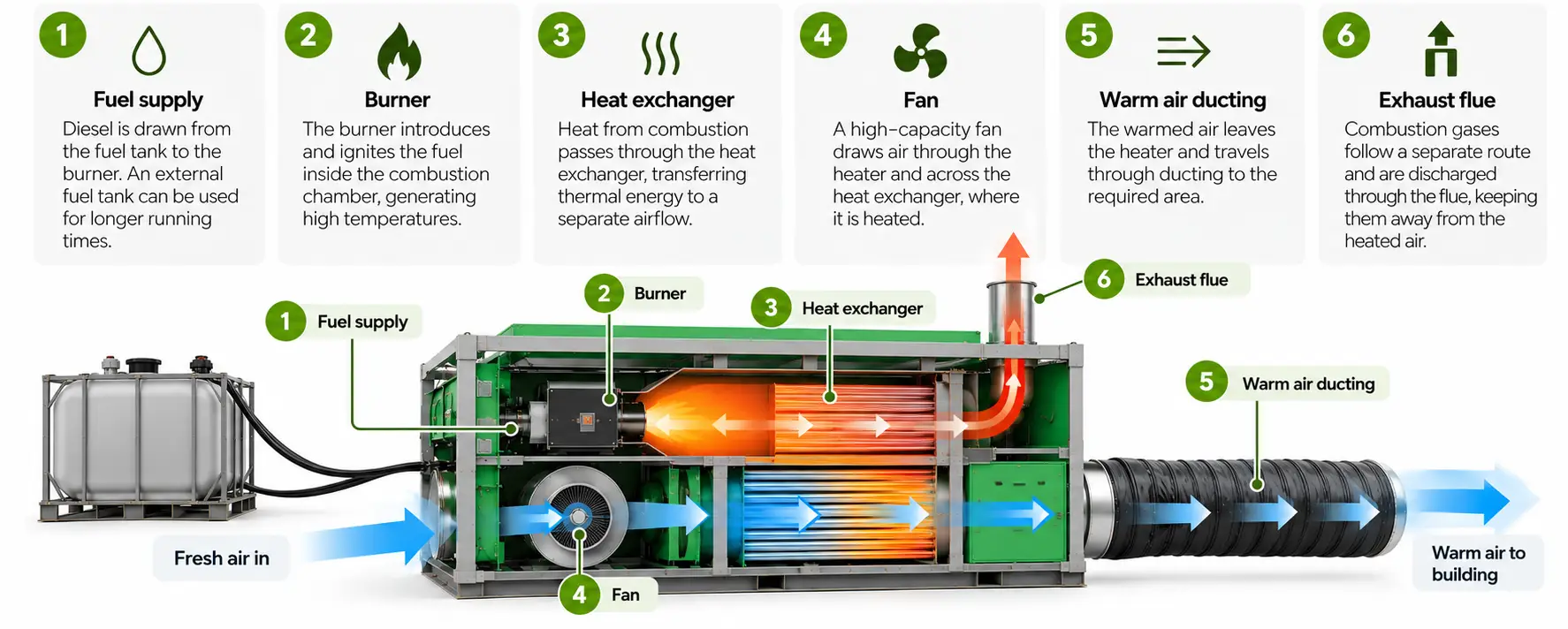
1. Fuel Is Supplied to the Burner
The process starts by supplying diesel or suitable fuel to the heater’s burner.
- Fuel is drawn from the heater’s fuel supply.
- The burner controls the delivery of fuel into the combustion chamber.
- External fuel tanks can be incorporated into the temporary heating installation to support longer operating periods.
Fuel consumption varies according to the heater. For example, Rapid Energy’s 45kW IDF heater is specified at up to 4.5 litres per hour, compared with 7.0 litres per hour for the 70kW and 14.8 litres per hour for the 150kW model.
2. The Burner Generates Heat
Once fuel reaches the burner, it is ignited within the combustion chamber.
- Combustion generates the thermal energy required for heating.
- The combustion takes place within the heater rather than in the building being heated.
- The resulting heat is transferred to the heat exchanger.
- Gases created by combustion are directed towards the separate flue system.
The objective at this stage is to generate heat that can then be transferred to the supply airflow.
3. Heat Passes Through the Heat Exchanger
The heat exchanger is central to how an IDF heater operates.
- Hot combustion gases heat the surfaces of the exchanger.
- A separate supply airflow passes across these heated surfaces.
- Thermal energy transfers through the exchanger into the supply air.
- The two air streams remain separated during this process.
Rapid Energy’s 70kW, 110kW and 150kW IDF heaters have 91% high-efficiency heat exchangers, demonstrating the importance of this component within the heater.
4. The Fan Moves Air Across the Heat Exchanger
A high-capacity fan moves air through the heater and across the heat exchanger.
As it passes across the heated surfaces, its temperature rises before the fan pushes it towards the heater outlet.
Two specifications are particularly important here:
- Airflow (m³/hr) – how much heated air the unit can move.
- Fan pressure – its ability to move that air through the connected ducting.
Airflow increases significantly across Rapid Energy’s IDF heater range. The 45kW provides 3,000m³/hr, the 70kW provides 3,800m³/hr, the 110kW provides 10,000m³/hr, and the 150kW provides 11,000m³/hr.
This is why kW output isn’t the only specification that matters when choosing an IDF heater.
5. Warm Air Is Delivered Through Ducting
Once the supply air has been heated, it leaves the unit through its outlet and enters the connected ducting.
- Ducting carries the warm air from the heater to the required area.
- Its arrangement can be designed around the building and site layout.
- Warm air can be directed towards the area where temporary heating is needed.
- Fan performance needs to be considered where longer or more demanding duct runs are required.
The equipment itself is designed with this connection in mind. For example, Rapid Energy’s 45kW and 70kW units have 400mm outlet connections, while the 110kW and 150kW models use 500mm outlets.
6. Combustion Gases Leave Through the Flue
While warm supply air travels towards the building, the products of combustion take a separate route.
- Combustion gases remain separate from the supply airflow.
- They travel through the heater’s exhaust system.
- The gases are discharged through the flue.
- The heater and flue therefore need to be correctly positioned as part of the overall installation.
This completes the two separate airflow paths that allow an IDF heater to deliver warm air into the required space.
How Does an IDF Heater Control Temperature?
An IDF heater also needs to regulate the heat being delivered rather than simply operating continuously.
A thermostat can monitor the temperature in the heated area and control the heater according to demand. This allows temperature control to form part of the complete temporary heating setup.
How Does Ducting Affect an IDF Heater Installation?
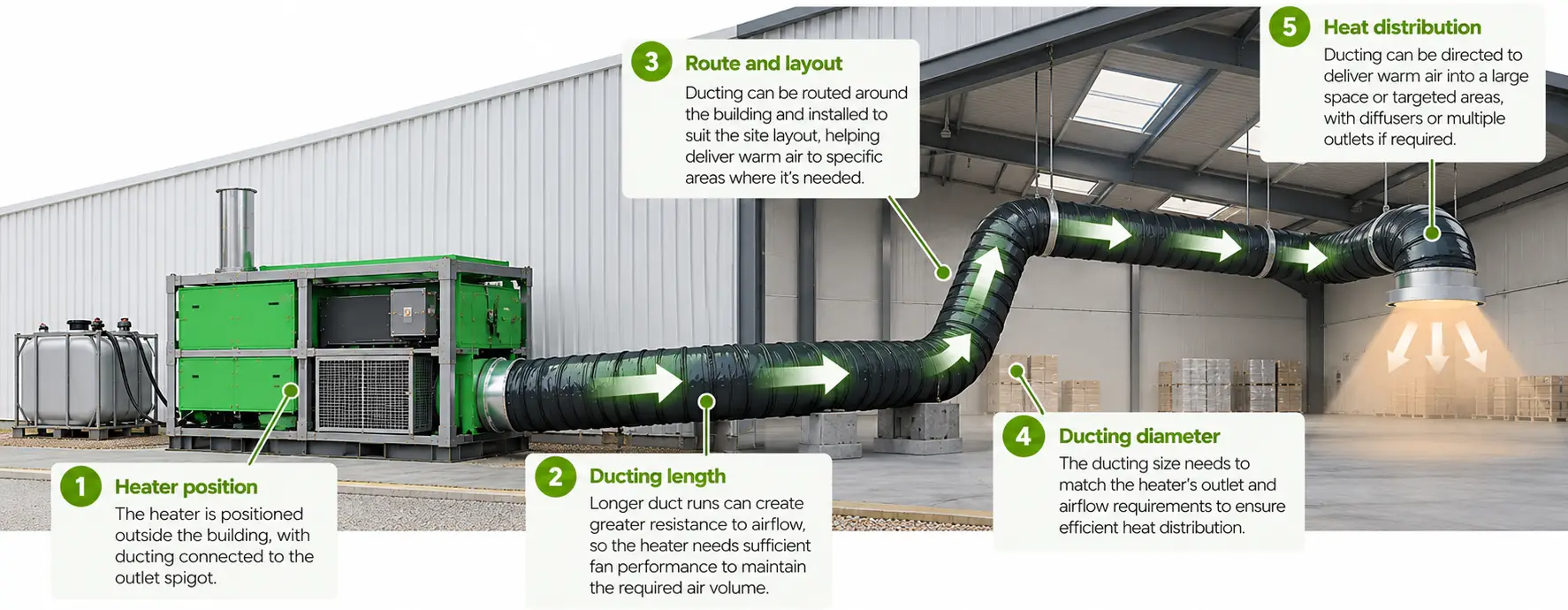
Ducting forms the connection between the IDF heater and the space requiring heat.
The length, diameter and layout of the ducting all influence how air moves through the temporary heating system. Longer or more complex runs create greater resistance, meaning fan pressure becomes an important consideration alongside heating capacity and airflow.
This is particularly relevant when the heater cannot be positioned immediately beside the area requiring heat.
Rapid Energy’s range demonstrates these differences in fan capability. The 45kW and 70kW units specify maximum ventilator back pressure of 200Pa, while the 150kW unit is rated at 500Pa.
The complete heater and ducting arrangement therefore needs to be considered rather than selecting equipment solely according to its kW rating.
What Determines IDF Heater Performance?
Several specifications work together to determine how an IDF heater performs:
- Heating capacity (kW) – the amount of heating capacity available.
- Heated airflow (m³/hr) – the volume of warm air the heater can deliver.
- Fan pressure (Pa) – important when moving air through ducting.
- Heat exchanger efficiency – how effectively combustion energy is transferred to the supply air.
- Fuel consumption – the fuel required while the heater operates.
- Ducting configuration – how the warm air is transported and distributed.
- Temperature control – how the heater responds as conditions within the space change.
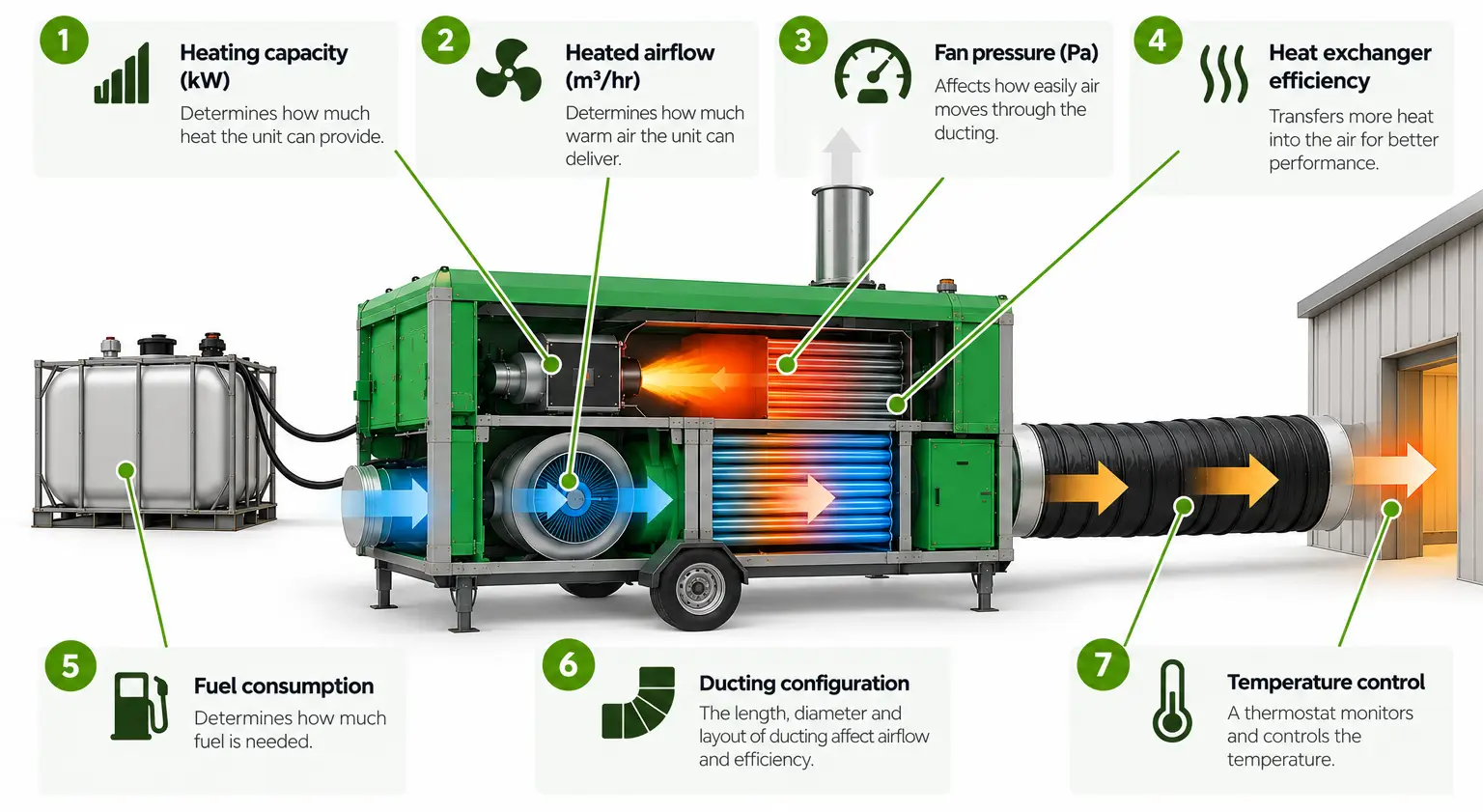
Considering these factors together gives a much more useful picture of IDF heater performance than looking at the kW figure alone.
Where Are IDF Heaters Used?
IDF heaters are well suited to commercial and industrial environments requiring large volumes of temporary warm air, including:
- Warehouses and distribution facilities
- Factories and manufacturing environments
- Construction and refurbishment projects
- Healthcare facilities
- Commercial buildings
- Emergency heating following HVAC or heating system failures
Rapid Energy has, for example, used a 150kW IDF heater with a 3,000-litre fuel tank, 20m of ducting and thermostat control to provide temporary heating to a large logistics warehouse.
Rapid Energy’s IDF Fleet
Getting the right temporary heating setup means considering more than heat output alone. Airflow, fan pressure, ducting, fuel supply, controls and site conditions all contribute to how the system will perform.
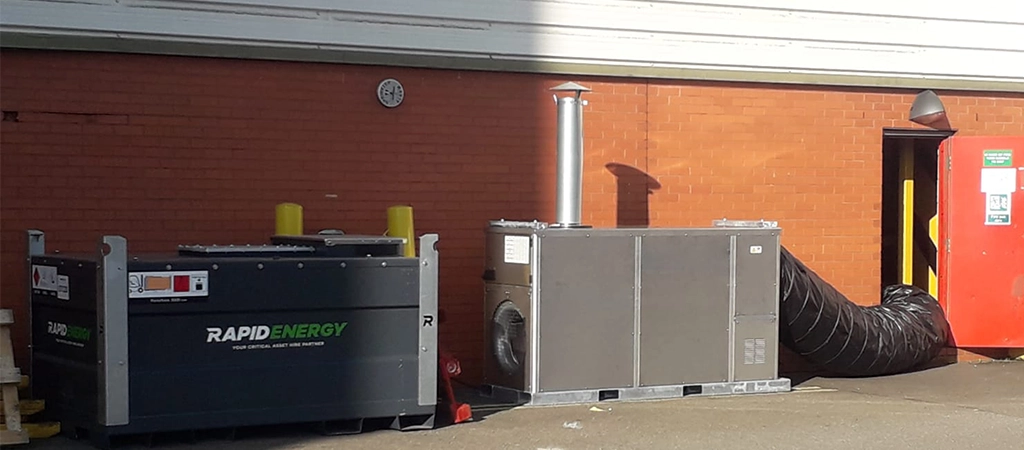
Rapid Energy’s IDF heater hire range provides options from 45kW through to 200kW, including the Jumbo 200kW, for commercial and industrial temporary heating applications. The different capacities and airflow capabilities allow temporary heating systems to be configured around the requirements of the building or application. Multiple units can also be used where additional heating capacity or distribution across different areas is required.
Our engineers can assess the heating requirement and site conditions, then help specify, install and commission an appropriate IDF heater setup.
Contact Rapid Energy for your IDF heater hire by calling 0800 464 7025 or email us at hire@rapidenergy.co.uk.
FAQs
What does IDF heater mean?
IDF stands for indirect diesel fired heater. The heater burns fuel within a combustion chamber and transfers the resulting heat through a heat exchanger to a separate supply airflow.
How does an IDF heater heat the air?
A burner generates heat inside the combustion chamber. A fan moves a separate stream of air across the heat exchanger, where it absorbs heat before being delivered through ducting.
Why does an IDF heater need a flue?
The flue provides a separate route for the gases produced during combustion, keeping them separate from the heated supply airflow.
Why do IDF heaters use ducting?
Ducting transports the heated air from the IDF heater to the area requiring temporary heating.
Does an IDF heater need electricity?
Yes. Components including the fan, burner and controls require electrical power. Requirements vary by model; Rapid Energy’s range includes both single-phase and three-phase configurations.