0800 464 7025


In commercial and industrial environments, temperature control isn’t just about comfort, it’s about keeping operations running, protecting equipment, and avoiding costly downtime.
That’s where temporary heat pump chillers come in.
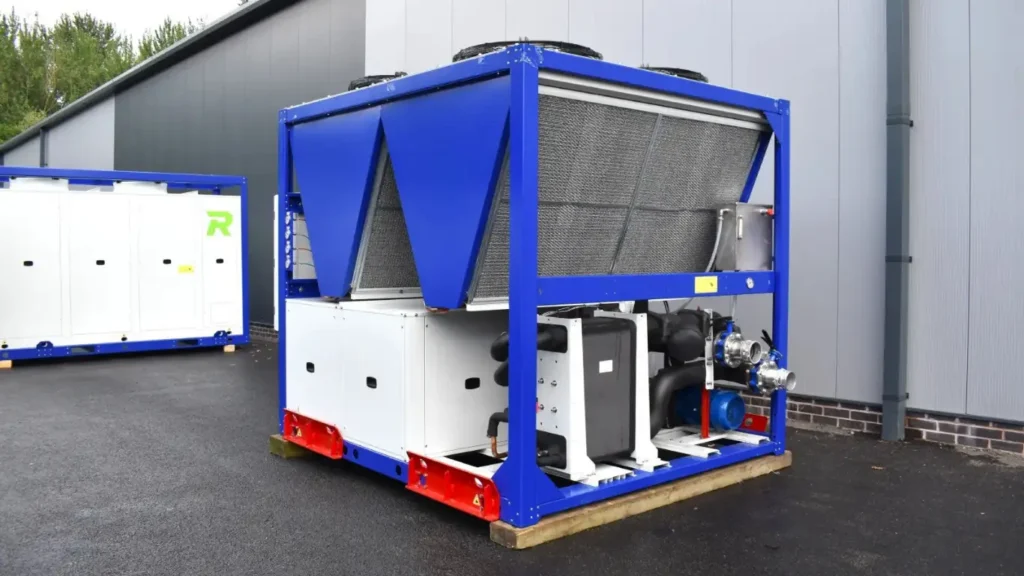
We provide fast, dependable heat pump chiller hire solutions designed for situations where failure simply isn’t an option, whether that’s an emergency breakdown, a planned shutdown, or additional capacity during peak demand.
If you’re already familiar with the basics of chillers, you’ll know the core principles and the refrigeration cycle (as shown below).

To find out what makes heat pump chillers different to standard chillers, how they work in practice, and why they’re so effective in temporary applications, read on.
What Makes a Heat Pump Chiller Different to a Standard Chiller?
A standard chiller removes heat.
A heat pump chiller does the same but it can also reverse the process to provide heating.
That means:
- One unit
- Two functions
- Less equipment on site

For temporary chiller hire, that flexibility is a big advantage. You’re not juggling separate systems or overcomplicating the setup; you’ve got a single, adaptable solution.
How Heat Pump Chillers Work
Heat pump chillers operate using a reversible vapour compression cycle. This is the same principle used in standard chillers, but with the added ability to switch direction depending on demand.
Cooling Mode
In cooling mode, the unit behaves like a conventional chiller:
- Heat is absorbed from the return water via the evaporator
- The refrigerant carries that heat through the system
- It’s then rejected to the outside air using condenser coils and fans
- Chilled water is returned to the building or process
Heating Mode
In heating mode, the cycle is reversed:
- The system absorbs heat into the refrigerant, which carries it through the refrigeration process
- The refrigerant is compressed to increase its temperature
- That heat is transferred into the water circuit
- Warm water is delivered back into the system

Why This Matters
Because the system is transferring heat rather than generating it, it offers:
- Higher efficiency compared to traditional electric heating
- The ability to provide both heating and cooling from one unit
- A simpler, more compact setup
Are Heat Pump Chillers Better for the Environment?
Overall, heat pump chillers are considered a more environmentally efficient option than traditional heating and cooling systems, particularly when used for heating.
In heating mode, they don’t generate heat in the same way as boilers or electric heaters. Instead, they transfer heat from the air into the system, which requires significantly less energy.
This results in:
- Lower energy consumption
- Reduced carbon emissions
- A more efficient alternative to conventional heating
While no system is completely impact-free, heat pump chillers offer a more sustainable approach to temperature control, especially in applications where heating demand is high.
Rapid Energy’s Heat Pump Chiller Fleet
We supply a range of air-cooled heat pump chillers for hire and rental, covering everything from smaller commercial setups to large-scale industrial demand.
Across our heat pump chiller hire fleet (30kW to 360kW), the same operating principle applies.
Here’s what that looks like in practice:
- Wide operating range:
All units operate in ambient conditions from -15°C to 45°C - Consistent temperature performance:
- Cooling: down to approximately -12°C LWT
- Heating: up to 50°C LWT
- Air-cooled design:
No need for cooling towers or additional infrastructure - Fast, practical connections:
Camlock fittings (2” or 4”) allow quick integration with existing systems - Built-in reliability:
Larger units feature dual refrigeration circuits, helping maintain operation in critical environments
Our Hire Range
30kW Heat Pump Chiller
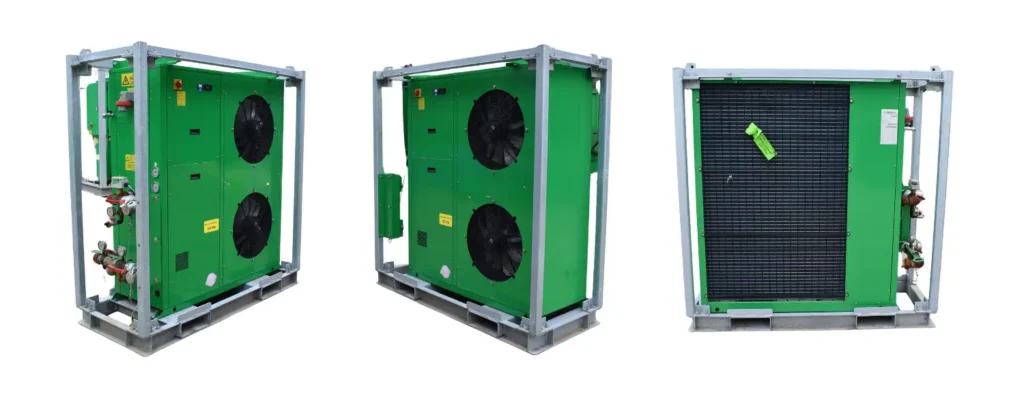
- Cooling: 29.1kW
- Heating: 26kW
- Flow rate: 84 LPM
- Power: 400V 3-phase
Good for:
- Smaller buildings
- Localised cooling/heating
- Quick temporary setups
A compact, self-contained unit with a single refrigeration circuit, making it a straightforward and reliable option for smaller applications where speed and simplicity matter.
100kW Heat Pump Chiller
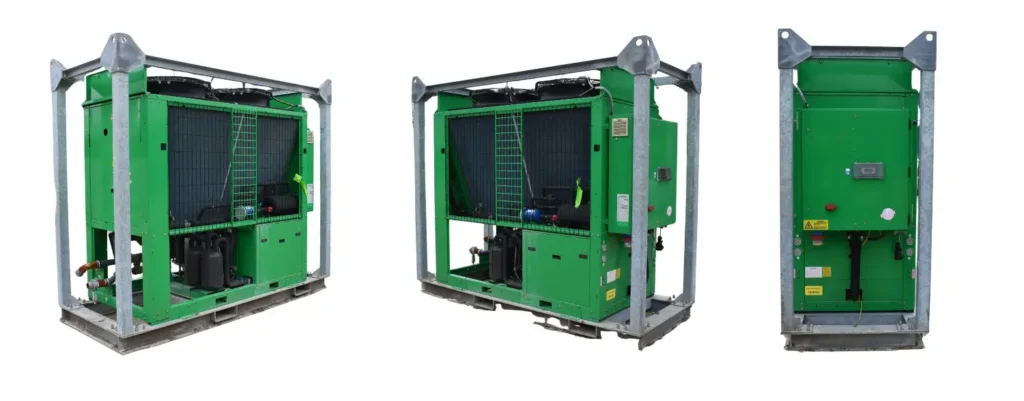
- Cooling: 100kW
- Heating: 119kW
- Flow rate: 306 LPM
- 2” camlock connections
Good for:
- Commercial buildings
- Offices, retail, leisure
- Medium process loads
Equipped with dual refrigeration circuits, this unit offers improved reliability and flexibility, making it a strong all-round choice for commercial environments and medium-scale demand.
200kW Heat Pump Chiller
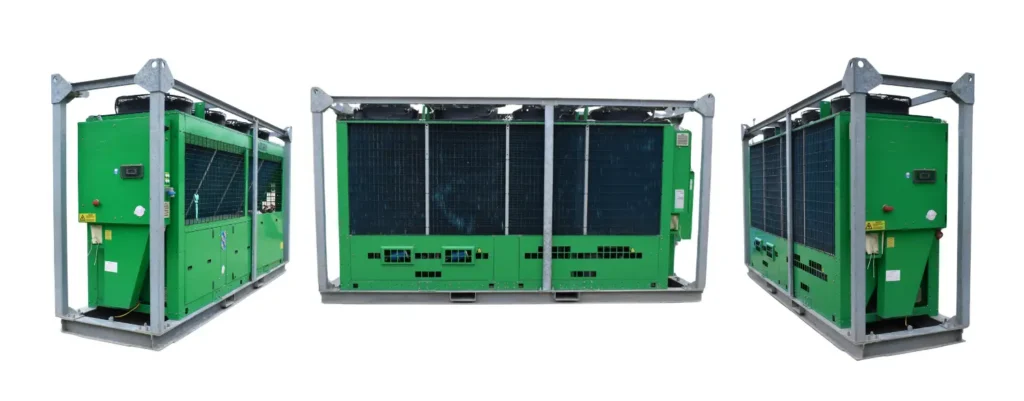
- Cooling: 226kW
- Heating: 254kW
- Flow rate: 648 LPM
- 4” connections
Good for:
- Manufacturing
- Large HVAC systems
- Process environments
Designed for more demanding applications, this unit combines high capacity with dual circuits, helping maintain performance and continuity on larger or more critical sites.
360kW Heat Pump Chiller

- Cooling: 360kW
- Heating: 361kW
- Flow rate: 1026 LPM
- BMS connectivity
Good for:
- Hospitals
- District energy / heat networks
- Major industrial sites
Our highest-capacity unit, featuring remote monitoring and dual refrigeration circuits, making it well suited to critical environments where performance, control, and reliability are essential.
Why They Work So Well for Rental
When bringing in temporary heat pump chillers, reliability and ease of deployment are just as important as performance.
Heat pump chillers are particularly well suited because they:
- Reduce the need for multiple systems (heating and cooling in one)
- Install quickly with minimal site disruption
- Adapt easily to changing site demands
- Provide a dependable solution in both planned and emergency scenarios
Whether it’s a short-term rental or a longer-term hire, they offer a practical, scalable way to maintain temperature control without compromise.
FAQs
Can one unit really provide both heating and cooling?
Yes. A reversing valve allows the system to switch between modes, so the same unit can deliver either heating or cooling as required.
What temperatures can they achieve?
- Cooling: typically down to -12°C
- Heating: up to 50°C
This suits most commercial HVAC and many industrial process applications.
Are they suitable for emergency situations?
Yes. Their self-contained design and quick connection setup make them ideal for rapid deployment when systems fail.
Can multiple units be used together?
Absolutely. Units can be combined to increase capacity or provide redundancy on critical sites.