0800 464 7025


Last updated: 20/06/2025
It’s an age-old debate in the workplace: someone’s too hot, someone else is freezing, and the thermostat debats begin.
But behind the daily disagreements lies a serious business issue: temperature impacts performance. When the temperature in your office or workplace is even slightly off, it can lead to discomfort, distraction, and a decline in productivity.
At Rapid Energy, we specialise in engineered temperature control hire solutions for commercial and industrial environments. We understand that temperature issues aren’t just about comfort, they can quickly become operational threats. In this blog, we examine the impact of office temperature on workplace performance and outline how appropriate climate control can support a productive and comfortable environment.
The Ideal Office Temperature: What Do the Experts Say?
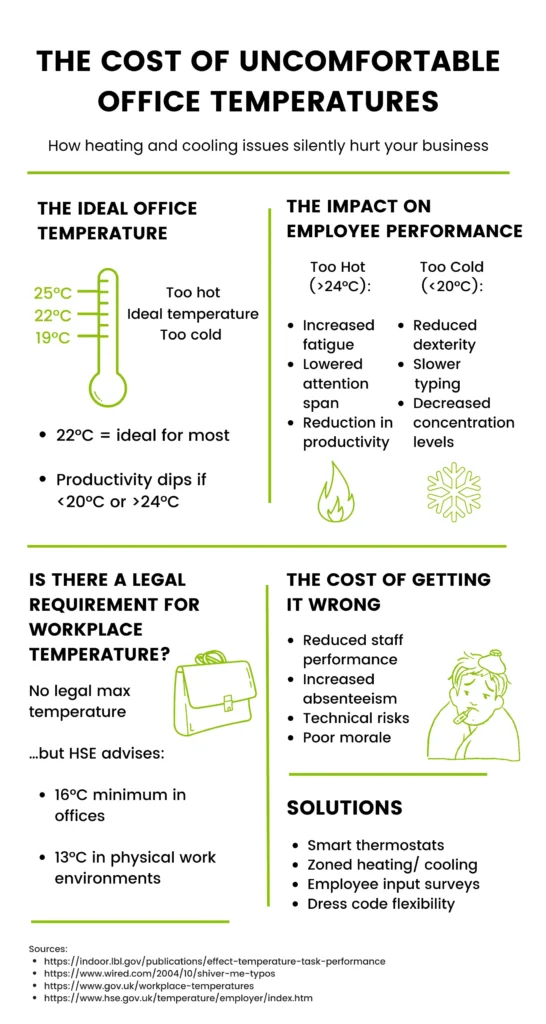
While individual preferences vary, research continues to show that 21°C to 23°C (69.8°F to 73.4°F) is the sweet spot for most office environments.
Why does it matter?
Because even small deviations from this range can negatively affect cognitive function, mood, and even physical coordination.
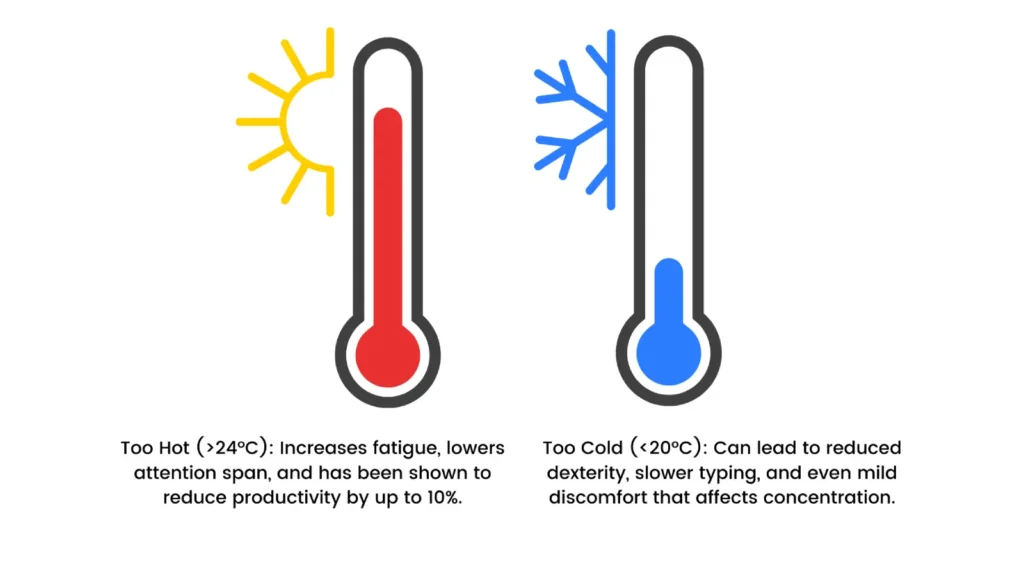
A 2006 study from Helsinki University of Technology and the Lawrence Berkeley National Laboratory found that performance peaks at around 22°C. After that, productivity drops sharply. Therefore, if an office’s heating or cooling system fails or is unable to meet seasonal demands, the impact can have a measurable effect on workplace performance.
Is There a Legal Requirement for Workplace Temperature?
In the UK, there’s no legally defined maximum temperature for workplaces. However, under the Workplace (Health, Safety and Welfare) Regulations 1992, employers must ensure that workplace temperatures are “reasonable.”
The Health and Safety Executive (HSE) recommends:
- A minimum of 16°C in offices.
- A minimum of 13°C in environments where physical work is carried out.
Although these are guidelines rather than legally binding thresholds, employers may still be held responsible if uncomfortable or extreme temperatures contribute to unsafe working conditions.
Given the increasing focus on employee wellbeing and environmental, social, and governance (ESG) performance, it is important that businesses address these concerns.
The Hidden Costs of Getting It Wrong
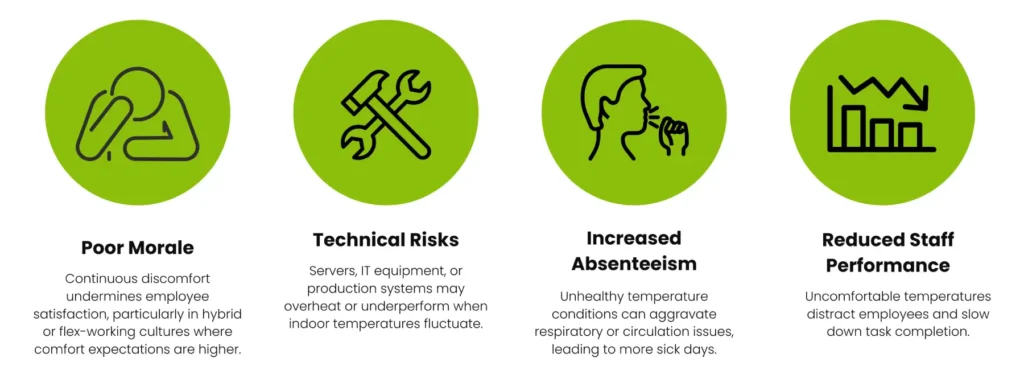
Temperature-related downtime does not always result from a complete HVAC failure. In some cases, insufficient system capacity during a sudden heatwave or an underperforming heating system during a cold spell can be equally disruptive.
Here’s how:
How Rapid Energy Can Help
At Rapid Energy, we don’t just supply heating and cooling equipment, we engineer site-specific, scalable temperature control solutions that help businesses maintain operational continuity.
Whether it’s:
- A planned maintenance shutdown
- An unexpected HVAC breakdown
- Increased demand due to seasonal pressure
…we respond fast, with high-performance solutions that keep your spaces at optimal temperature.
What We Offer:
- Emergency and planned boiler hire, heater hire, chiller hire and temporary portable cooling units.
- Remote monitoring and responsive engineering support, ensuring consistent system performance and rapid fault resolution.
- Compliance with ISO standards and delivery of site-specific risk assessments to support regulatory compliance and operational safety.
- Customised hire packages tailored to your workspace layout, occupancy levels, and infrastructure.
With Rapid Energy, you’re not just hiring equipment, you’re partnering with a team that understands what’s at stake. We deliver fast, dependable, and professionally engineered solutions designed for business continuity.
Call our 24/7 team on 0800 464 7025 or email us at hire@rapidenergy.co.uk to speak to a specialist today.
FAQs
Q: What is the ideal office temperature for productivity?
A: The ideal office temperature for productivity is typically between 21°C and 23°C. Research shows that performance peaks at around 22°C, making it the best temperature for maintaining focus, comfort, and efficiency in most workplaces.
Q: Is there a legal temperature for office working conditions in the UK?
A: While there’s no legal maximum office temperature, the Workplace (Health, Safety and Welfare) Regulations 1992 require a “reasonable” temperature. The Health and Safety Executive (HSE) recommends a minimum of 16°C for office work and 13°C for physically active jobs.
Q: What’s considered a reasonable or acceptable office temperature?
A: A reasonable office temperature generally falls within the range of 20°C to 24°C, depending on activity level, building design, and season. Anything significantly outside this range may reduce comfort or performance and could violate occupational health and safety guidelines.
Q: My office is too hot – what can I do?
A: If your office is consistently too hot, speak to your facilities team. If you’re responsible, consider temporary cooling solutions, such as portable AC units or chiller hire from Rapid Energy. We offer fast, scalable cooling systems to restore comfortable conditions quickly.
Q: How cold is too cold in the workplace?
A: If the temperature drops below 16°C in an office setting, it may be considered unreasonably cold. Cold office temperatures can lead to discomfort, reduced concentration, and health risks. Temporary boiler or heater hire can help you maintain a safe working environment.
Q: What’s the best office temperature for air conditioning systems?
A: The best AC temperature setting for offices is typically 22°C, which balances energy efficiency with occupant comfort. Overcooling can be as disruptive as overheating, so it’s important to monitor and adjust based on real-time conditions and occupancy levels.
Q: Can office temperature really impact employee performance?
A: Yes. Even small fluctuations in office temperature can impact cognitive function, mood, and productivity. Too cold, and employees become sluggish; too hot, and focus drops. That’s why temperature control is critical to business performance and employee wellbeing.